Have you ever found yourself in this situation: you have rented a "god-tier" server with massive RAM from a top-tier cloud provider, and you have optimized your code to the limit, yet your users still complain about "lazy" loading?
It feels like an endless frustration. On your local monitor, everything runs in milliseconds, but in the real world, data seems stuck in an invisible digital traffic jam. The problem is often not how powerful your server is, but how far away your server is located.
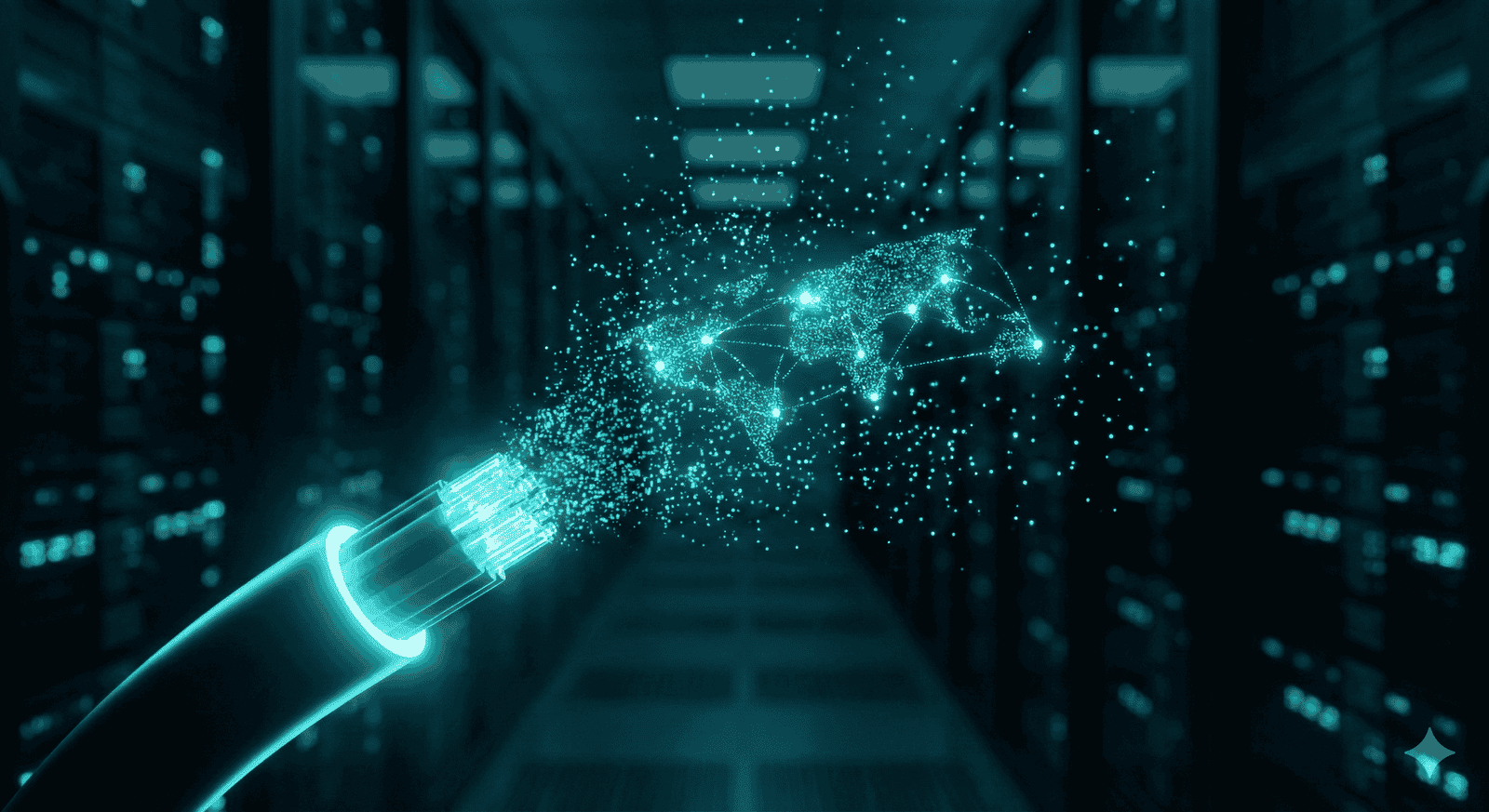
We often forget that even though data travels at the speed of light, it must still obey the laws of physics. Light inside fiber optic cables takes time to cross the ocean. If your server is in Singapore and your user is in Papua, there are thousands of kilometers of infrastructure to traverse. This is what we call the latency barrier. This is where Edge Computing steps in—not as a passing trend, but as an unsung hero redefining how the internet works.
Cloud vs. Edge: Understanding the Paradigm via the Pizza Analogy
To understand Edge Computing, let’s set aside technical terms for a moment and imagine a pizza delivery service.
In the Traditional Cloud Model, imagine there is only one giant kitchen in the center of Jakarta. If someone in Bali orders a pizza, a courier must fly from Jakarta to Bali. No matter how great the oven in Jakarta is or how fast the chef cooks, the travel time will still result in the pizza arriving cold and wilted.
In the Edge Computing Model, the restaurant builds thousands of small kitchens or "distribution points" (Points of Presence) in every city. When the person in Bali orders, the kitchen just 10 minutes from their house processes the order. The result? The pizza arrives hot, fresh, and instant.
In web architecture, these "small kitchens" are server nodes placed at the "edge" of the network, as close as possible to the user's device. It no longer moves the user to the data center but brings the data center to the user's doorstep.
Don't Just Talk Theory, Try These Edge Tools Now
If you think Edge Computing is only for giants like Netflix, you are dead wrong. Even individual developers can use this technology for free or cheaply using the following tools:
- Cloudflare Workers: The king of this sector. You can deploy JavaScript code that runs in 300+ cities worldwide in seconds. The latency? Near zero.
- Vercel Edge Functions: A favorite among Next.js users. Your backend code is instantly distributed to a global edge network, making dynamic websites feel as fast as static ones.
- AWS Lambda@Edge: For those already comfortable in the Amazon ecosystem. This feature allows your Lambda code to be executed at the CloudFront location closest to the user.
So, stop blaming your expensive server. The problem isn't "Power", it's "Distance".
Why Web Developers Should Make This Move Now?
For software developers, Edge Computing is not just an infrastructure marketing term. It changes the way we write code, especially with the emergence of Edge Runtime technology, which is lighter than conventional Docker.
1. Brutally Eliminating Round Trip Time (RTT)
Every time a user interacts—such as clicking a "Buy" button—a "Round Trip" occurs. The request is sent to the server, processed by backend logic, and the response is sent back.
If the server is overseas, this Round Trip Time (RTT) can take 200ms to 500ms. With Edge Computing, application logic (such as form validation or authentication) is executed at the nearest node. RTT is slashed to under 10ms. For the human eye, this is the difference between "waiting for the system to respond" and an "interaction that feels natural."
2. Distributed Security (The Immune System)
The old paradigm taught us to build a "Castle Fortress" around a central server. However, if that fortress is breached by a DDoS (Distributed Denial of Service) attack, everything is lost.
Edge Computing offers an "Immune System" approach. Since data processing occurs at thousands of points, an attacker must disable thousands of nodes simultaneously to stop the service completely. Furthermore, encryption and data validation can be performed closer to the source. We can intercept malicious traffic exactly at its entry point before it ever touches our primary infrastructure.
3. Bandwidth Efficiency and "Data Gravity"
Sending large amounts of raw data from thousands of IoT devices to a central server is a massive waste of network costs. The Edge concept allows devices to filter data locally.
Imagine a smart security camera that records 24/7. Without Edge, it would continuously send empty video to the cloud (wasting bandwidth). With Edge, the AI inside the camera will only send video clips to the Cloud only if human motion is detected. This saves storage and bandwidth costs by up to 90%.
Behind the Scenes: WebAssembly and V8 Isolates
This is the part that is rarely discussed: how can a small server in a remote area be as powerful as a central server? The answer isn't by stacking CPUs, but through execution efficiency.
Modern Edge architecture heavily utilizes WebAssembly (Wasm) and V8 Isolates. Unlike a Virtual Machine or Docker, which takes a long time to boot, V8 Isolates allow thousands of queries to run within the same process with very strict security isolation. This allows the "Cold Start" (the time required for the server to wake up) to drop from seconds to zero milliseconds. Your code is always ready, always "hot," wherever the user is.
Real-World Applications Changing Industries
The true potential of this technology lies in sectors that require millisecond accuracy:
Autonomous Vehicles: A smart car cannot wait for a server in the cloud 500km away to decide whether to hit the brakes when a cat crosses the street. The decision must be made at the "Edge" (inside the car itself).
Digital Health: Heart monitoring devices using AI must be able to detect anomalies in real-time without depending on a stable internet connection to a central server. A one-second delay can mean a life.
Online Gaming & Metaverse: An immersive experience is impossible if there is lag. Edge Computing ensures that player positions are synchronized on local servers, making movement feel smooth and uninterrupted.
Challenges: "The Great Synchronization"
Of course, no technology comes without challenges. The biggest issue in Edge is Data Consistency. How do you ensure that stock data at a node in Jakarta is exactly the same as the node in London at the same time?
This is why supporting technologies like Edge-ready databases (such as Turso or Cloudflare D1) have emerged, using smart synchronization protocols to replicate data instantly across the globe without sacrificing performance.
Conclusion: Proximity is the Future
We are moving toward an era where the internet no longer feels like a series of rigid requests and answers, but like a smooth, seamless flow of data. Cloud Computing is not dying; it will remain the place for massive data storage and heavy AI model training. However, our daily interactions with technology will be fully dominated by the Edge.
For IT professionals, shifting from centralized thinking to distributed thinking is a must. Understanding how to optimize code to run in an Edge environment will be the key differentiator between an average developer and the systems architect of the future.
The world is shrinking, and in the world of technology, physical proximity (network physics) is the key to absolute efficiency. It is time to stop thinking only about how powerful your server is and start thinking about how close your server is to those who use it.