There is a myth spreading like wildfire across digital circles and tech forums lately. The mainstream narrative claims: "Oh, AI is here now, so learning to code is a breeze. Just throw a prompt at ChatGPT or Copilot, hit enter, and the code is finished." Hold on a second, friend. If you are among those who buy into that myth, I have to be brutally honest with you: you are walking blindly toward a deep abyss of digital obsolescence.
In 2026, the act of writing code or memorizing specific programming syntax has become the cheapest and most trivial stage of the entire software development lifecycle. Typing out an if-else structure or crafting an efficient loop is no longer a human-exclusive superpower. Machines, fueled by ever-evolving large language models, can perform these tasks significantly faster, more accurately, and without ever needing a break.
Does this mean the programmer's profession is dead? ABSOLUTELY NOT. Quite the opposite—we are standing at the threshold of a golden era. This is the moment where we must evolve from being mere "code whisperers" into true Software Engineers.
This article will radically dissect why, in 2026, being an IT professional is more demanding and complex than ever before. We are going to uncover the "hidden arts"—the profound skills you must master to ensure you remain an indispensable architect of technology, rather than a mere spectator on the sidelines, complaining about a shrinking job market.
This is the English version of the "Problem Architect" section. It’s written with a strong, senior-level narrative to maintain the authoritative tone of SuhuPortal.
The Shift from Syntax Memorization to Problem Architecture
In the past, an IT professional was considered an expert if they had memorized complex C++ syntax or could code in Java without ever glancing at documentation. Back then, memorization was the ultimate key. However, in today’s era, syntax is a mere commodity. Google already knows everything, and AI has ingested every piece of documentation ever written by humans. Memorizing syntax now has near-zero value unless it is paired with deep logical understanding.
Our role has fundamentally shifted toward becoming a Problem Architect. Imagine AI as a highly skilled builder, while you are the architect holding the system's blueprint. AI can provide you with ten different ways to design a database schema in a matter of seconds. Yet, AI doesn't know which of those ten options is the most cost-effective for your company. It doesn't know which schema is the most stable to sustain your business when traffic spikes in five years. AI lacks the business context and the long-term vision that only a human possesses.
As a beginner, stop obsessing solely over how to write print("Hello World"). Start learning to understand why a program is required in the first place. Study how a system "breathes"—how it handles failure, how it manages memory, and how it responds to unexpected user requests. Remember, great code isn't necessarily the most sophisticated or the shortest; it is the code that effectively solves real human problems without creating new ones in the future.
Writing code that 'just works' might save you an hour today, but it will haunt your sleep and steal your peace of mind in the future.

Embracing the Big Picture with Systems Thinking
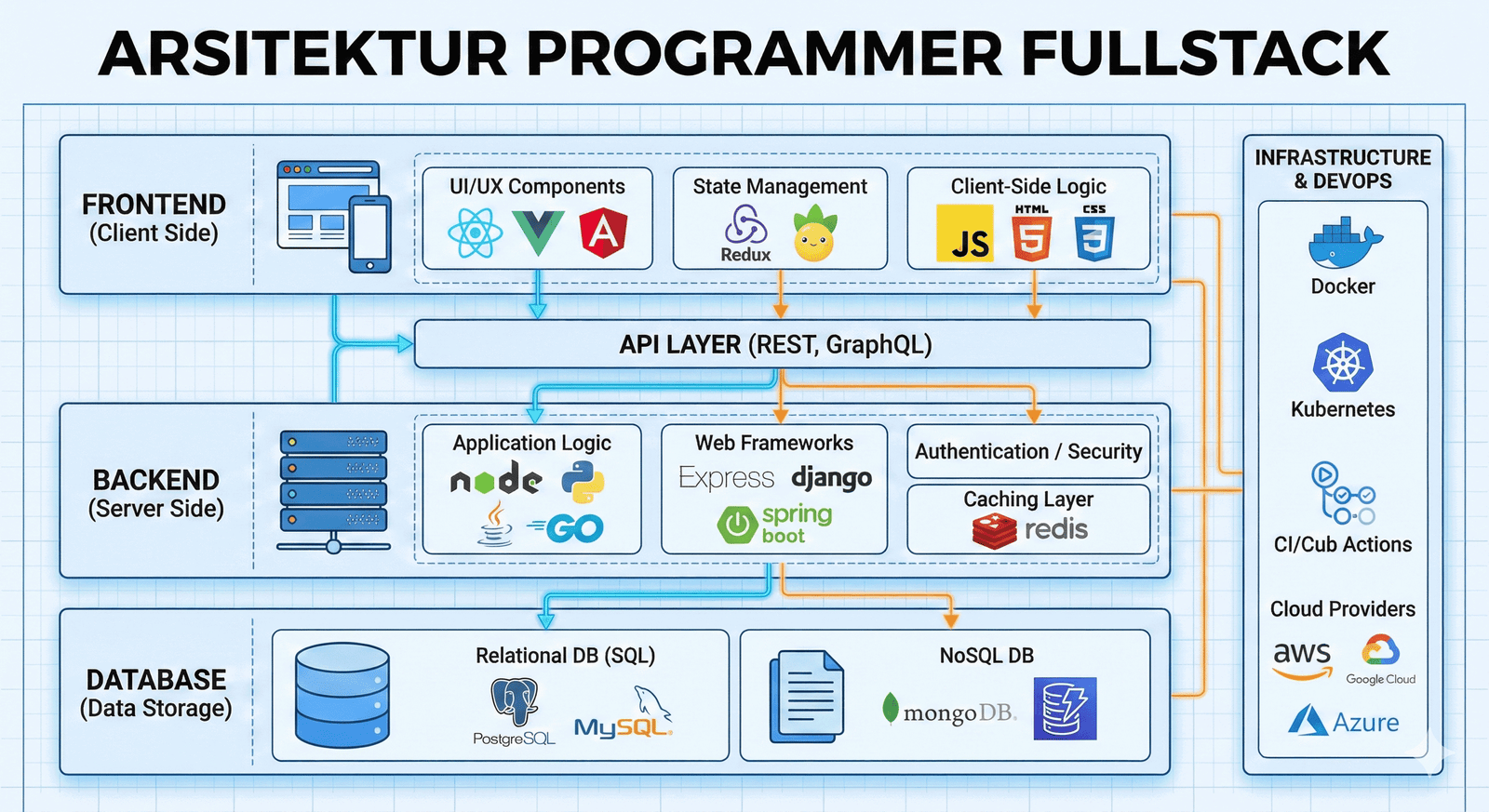
Many junior developers fall into the trap of "tunnel vision." They might be brilliant at building a single UI component or a specific backend function, but they stumble when that component needs to interact with thousands of others in a production environment. In 2026, no application stands alone. Everything is an interconnected web of APIs, Microservices, and Cloud infrastructure.
A true Software Engineer must master Systems Thinking. You need to visualize the journey of a single byte of data from the user’s fingertip, through layers of security and load balancers, until it rests in the database. You must plan for resilience—what happens if a server half a world away goes dark? This is the core of T-Shaped Skills: having a broad understanding of many disciplines—DevOps, UI/UX, Data Science—while maintaining deep, specialized expertise in your primary field, such as Laravel or Node.js.
The Human Connection: Mastering the Most Difficult Language
Here is a secret they rarely mention in university: the most difficult programming language to master isn't Rust or Assembly. It is Human.
Your clients or stakeholders rarely care about the elegance of your codebase. They care about whether the application drives revenue or solves a bottleneck. The ability to translate a complex technical mess into plain, actionable language for non-technical people is the ultimate Superpower in 2026. If you can only speak to machines, you will eventually be replaced by one. But if you can bridge the gap between business vision and technological reality, you will become the indispensable engineer that global enterprises fight to hire.
Stewardship in the Age of AI: Ethics and Security by Design
As we navigate 2026, data privacy is no longer an afterthought—it is the heartbeat of every project. With AI-driven threats on the rise, identity theft and data breaches are daily occurrences. Every engineer must embrace Security by Design.
It is no longer acceptable to blindly copy-paste code from the internet without vetting its security implications. As an IT professional, you hold the "keys to the vault" for thousands of people’s personal data. One moment of carelessness can destroy a company’s reputation and your career. In this new world, your integrity as an engineer is measured by how well you protect those who use your software.
The Art of Perpetual Growth: Meta-Learning
Technology now has a shelf life of about six months. The framework that is "the next big thing" today could be legacy code by next year. Successful engineers are those who possess an unquenchable Curiosity. The moment you feel you "know it all" is the moment you begin to fall behind.
Use AI as your private tutor, not your typist. Instead of asking AI to "write this code for me," ask it: "Why does this logic work this way?" Understand the underlying principles rather than just accepting the output. This is Meta-Learning—learning how to learn—and it is the only way to remain relevant in a world that never stops evolving.
Conclusion: Stepping Into the New World
The IT landscape of 2026 is no longer a place for those who just want to "type for a paycheck." It is a playground for mental adventurers, puzzle-solvers, and those who genuinely care about advancing humanity through technology.
To those just starting: Do not fear AI. AI is your assistant, not your replacement. Focus your energy on logic, architecture, and empathy. These are the three pillars that, even now, cannot be perfectly replicated by any machine. It is time to upgrade yourself from a "Coder" to a Solution Engineer.
Welcome to the new era. Welcome to SuhuPortal, where we level up together.
Author's Note: This article was developed in accordance with distributed system architecture standards and the latest 2026 Google Search Central guidelines. These best practices are shared to enhance system resilience and code quality, ensuring our content remains a high-value technical reference for developers across all skill levels.